Radio, Cinema and Television Study in Turkey 2025: A Gateway to Creativity and Media Professionalism

جدول المحتويات
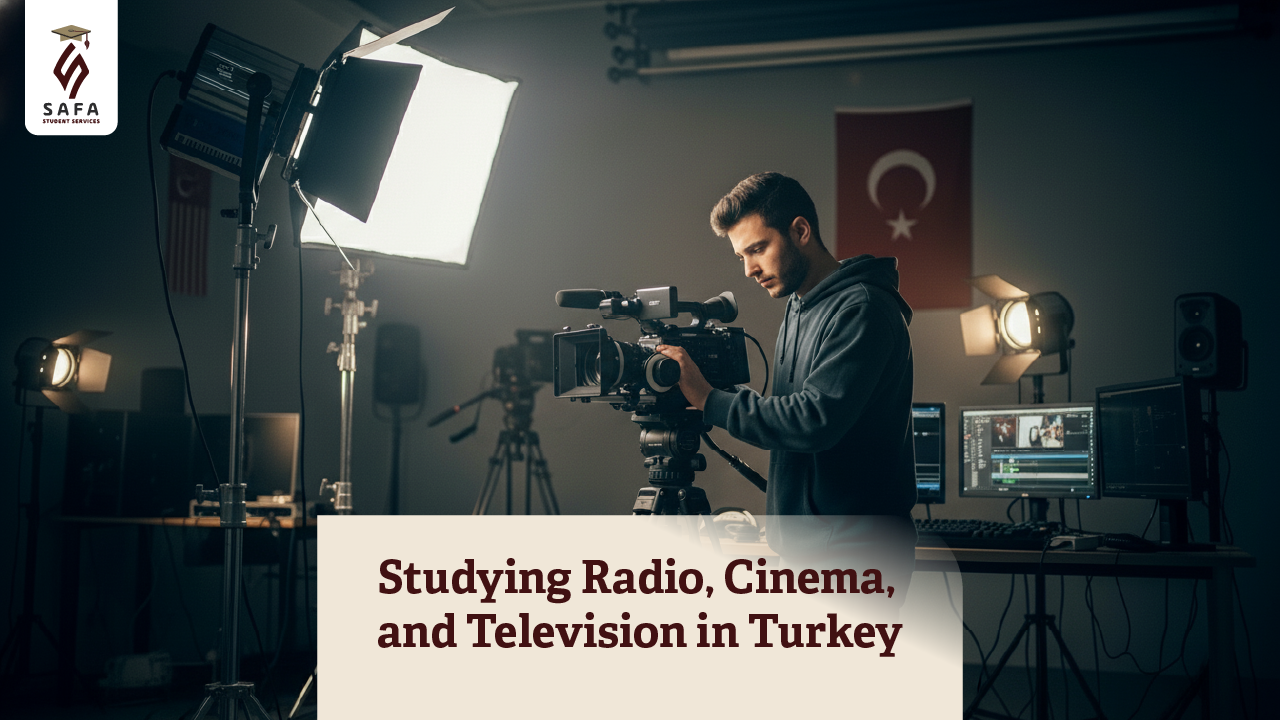
In today’s world, where the media and entertainment industry is developing at an unprecedented pace, the field of “Radio, Cinema, and Television” has become pivotal for those wishing to enter this exciting and influential field. With the increasing production and global popularity of Turkish drama and film, coupled with the development of the radio and television broadcasting sector, Turkey has emerged as an attractive destination for ambitious international students aspiring to study Radio, Cinema, and Television in Turkey in 2025. This comprehensive article will provide you with a detailed guide covering everything you need to know about this specialization, from its definition and academic aspects to admission requirements, costs, and career prospects.
What is the field of Radio, Film, and Television? And why is it important in 2025؟
The field of “Radio, Film, and Television” is an academic and applied discipline that equips students with the knowledge and skills necessary to work in the audiovisual media industry. This specialization covers multiple aspects, including:
- Radio and television production: from the initial idea, scriptwriting, directing, filming, editing, to broadcasting and post-production.
- Cinema: The study of the history of cinema, types of films, filmmaking (directing, cinematography, editing, production, screenwriting), film criticism.
- New media and digital platforms: Understanding the impact of technology on media, digital content production, online streaming, and keeping up with changes in audience behavior.
- Media theory: The study of the impact of media on society, professional ethics, and media laws.
In 2025 and beyond, this specialization will become enormously more important due to the following global trends:
- The digital content revolution: With the increasing popularity of streaming platforms such as Netflix, YouTube and TikTok, there is a huge demand for professional content producers.
- The growth of the Turkish film and television industry: Turkish drama has become a global phenomenon, opening up wide horizons for film and television professionals.
- The evolution of production technologies: the use of virtual reality (VR), augmented reality (AR), and artificial intelligence in media production requires experts familiar with these technologies.
- Multi-platform media: The ability to produce and distribute content across diverse platforms (television, radio, internet, podcasts) has become an essential skill.
This continuous development makes graduates of this specialization creative, technically skilled, and able to adapt to rapid changes in the media industry.
Advantages of studying Radio, Cinema and Television in Türkiye 2025
Türkiye offers a range of advantages that make it an attractive choice for studying this major:
- A thriving media industry: Türkiye, and especially Istanbul, is an important center for television and film production in the region and the world, providing opportunities for practical training and exposure to a real industry environment.
- Quality of Education and Practical Training: Turkish universities emphasize combining theory and practice. These universities often have well-equipped television and radio studios, editing suites, and state-of-the-art film equipment for student training.
- Affordable cost: Compared to universities in Western Europe or North America, the costs of studying and living in Türkiye are more economical, allowing for high-quality education on a reasonable budget.
- English-language programs: Many private Turkish universities and some public universities offer radio, film and television programs entirely in English, removing the language barrier for international students.
- Geographical and cultural location: Türkiye is a bridge between East and West, providing students with a unique understanding of diverse cultures, which is a major advantage in the global content industry.
- Networking opportunities: Building relationships with professionals in the Turkish and international media industry through workshops, festivals, and training.
- Film festival opportunities: Türkiye hosts many international film festivals that students can participate in and benefit from.
What will you study in the Radio, Film and Television major?
The bachelor’s program in this major is typically 4 years long and covers a wide range of subjects, including:
- Television Production: Fundamentals of Television Directing, Program Production (News, Entertainment, Documentary), Television Editing, Television Filming Techniques.
- Radio production: History of radio, the art of sound, preparation of radio programs (talk, music), sound engineering, sound editing.
- Cinema: History of world and Turkish cinema, film genres, film analysis, screenwriting, film directing, cinematography, film editing.
- Scriptwriting: developing ideas, building characters, plot, writing dialogues for radio, television, and film.
- Filming and editing (montage): Using professional cameras, lighting techniques, and editing software (such as Adobe Premiere Pro, Final Cut Pro).
- New media and digital platforms: content production for social media, digital marketing, podcasts, live streaming.
- Media theory and criticism: Media discourse analysis, the impact of media on society, media ethics.
- Management and Production: Principles of media production management, budgeting, and marketing for media businesses.
In addition to theoretical material, the program places a strong emphasis on practical projects, producing short films, radio and television programs, and digital media projects.
Admission requirements for studying Radio, Cinema and Television in Türkiye 2025
Admission requirements for international students to study Radio, Cinema and Television at Turkish universities vary depending on the type of university and the language of study:
1. Public universities:
- High school diploma: Good to high average (usually no less than 70-80%, but technical majors may be more flexible).
- Admission tests:
- YÖS Test: This is the Turkish aptitude test for foreign students, and it is required by most public universities.
- The SAT (SAT) test: Some public universities accept the SAT (SAT I) test as an alternative to the YÖS exam, and require a competitive score.
- Talent exams: Many universities, especially fine arts and communication colleges, require students to pass a specialization-specific talent exam (such as drawing, photography, or an interview to assess artistic and creative inclinations).
- Proficiency in the language:
- Turkish language: If the program is in Turkish, proof of language proficiency is required through the TOMER test at level C1, or the student can study a preparatory year for the Turkish language.
- English language: If the program is in English, proof of proficiency is required through tests such as TOEFL or IELTS, or the student can pass the university’s language placement test.
2. Private (endowment) universities:
- High school diploma: with an acceptable grade (may start from 50-60%, and preferably higher).
- Admission tests: Most private universities do not require YÖS or SAT tests as a basic requirement, and are satisfied with the high school GPA.
- Proficiency in the language:
- Turkish language: Same requirements as for state universities if the program is in Turkish.
- English language: Same requirements as government universities (TOEFL/IELTS) or passing the university’s language placement test.
- Additional documents: Some universities may require a letter of motivation, a resume, a personal interview, or a portfolio of the student’s previous artwork (drawings, photographs, short videos) to demonstrate their talent.
Important advice:Given the artistic and creative aspect of this major, aptitude tests and portfolio may be decisive factors in admission, even if your academic grades are good.
Cost of studying Radio, Cinema and Television in Türkiye 2025
Türkiye offers a variety of options in terms of cost, making it suitable for different budgets:
1. Fees for public universities:
- Public universities are the most economical option. Annual tuition fees for studying radio, film, and television at these universities typically range from US$300 to US$1,500.
- Programs taught in English may have slightly higher fees than those taught in Turkish.
2. Private university fees:
- Annual fees for studying Radio, Film and Television at private (endowment) universities typically range from US$3,000 to US$9,000.
- Private universities with a high academic reputation and state-of-the-art facilities may have higher fees within this range.
- Many private universities offer options for paying fees in installments (annual or quarterly) to make things easier for students.
Cost of living in Türkiye 2025:
- Average monthly cost: Typically ranges from US$350 to US$700.
- Accommodation:
- Government housing (KYK): about $50-$150 per month (cheapest option).
- Private accommodations: $150-$400 per month.
- Shared/private apartments: $200-$600 per month or more depending on location and city.
- Food: $100-$200 per month.
- Transportation: Approximately $20-$40 per month using a discounted student transportation card.
- Health insurance: Mandatory, about $100-$150 per year for government insurance (SGK).
- Personal expenses: $50-$150 per month (books, entertainment, school supplies).
Tip: Major cities like Istanbul, Ankara, and Izmir have a higher cost of living.Compared to smaller cities.
Top universities for studying Radio, Cinema and Television in Türkiye 2025
Many Turkish universities offer excellent programs in this field, including:
- Istanbul University: It is one of the oldest and most prestigious universities, and it has a strong department for radio, cinema and television, especially in the theoretical and academic aspects.
- Mimar Sinan Fine Arts University: Known for its focus on fine arts, it has strong departments in film and television, with a distinctive artistic and creative environment.
- Ankara University: One of the leading public universities, it has prestigious programs in the field of communication and media, including specializations in radio, cinema and television.
- Ege University: Located in Izmir, it offers good programs in communication and media with a focus on the practical side.
- Yeditepe University: A private university in Istanbul, offering English-language programs in communication and arts, with modern facilities.
- Bahçeşehir University: A popular private university in Istanbul, offering programs in communication and media (including radio, film and television) in English, and distinguished by its location and industry connections.
- Kadir Has University: A private university in Istanbul, known for the strength of its departments in design and communication, and has programs that focus on the digital and applied aspects.
- İstinye University: A modern private university in Istanbul, offering programs in fine arts and communication with modern studios.
Career prospects for Radio, Cinema and Television graduates 2025
Graduates of this specialization enjoy wide and diverse career opportunities in the rapidly growing media and entertainment sector, which is witnessing continuous innovation.
Potential areas of work:
- Film and television production:
- Film/TV Series/TV Program Director
- Producer
- screenwriter
- Cinematographer (Director of Photography)
- Editor
- Sound Designer/Sound Engineer
- Lighting designer
- Assistant Director/Producer
- Radio:
- Radio program producer and presenter
- Radio director
- Radio sound engineer
- announcer
- Digital media and new platforms:
- Digital content producer (for YouTube, TikTok, digital platforms)
- Podcast developer
- Digital Marketing and Social Media Specialist
- Motion Graphics Designer
- Advertising and public relations agencies:
- Media Officer
- Public Relations Specialist
- Advertising content producer
- Academic institutions:
- A researcher or academic after completing postgraduate studies.
In Türkiye, with the flourishing television and film industry, there is a growing demand for talent in this field. Opportunities also exist in private and state-run television and radio stations, production companies, and advertising agencies.
Tips to boost your career opportunities:
- Build a strong portfolio: Compile your best work and projects (short films, montages, sound recordings) into a professional portfolio that showcases your creative and technical skills.
- Practical training: Look for training opportunities at production companies, television or radio stations, or media agencies while studying.
- Mastering video editing and design software: such as Adobe Premiere Pro, After Effects, Photoshop, DaVinci Resolve.
- Continuous learning: The media industry is evolving rapidly. Stay up-to-date with the latest technologies and trends.
- Building a network: Attend festivals and workshops, and connect with professionals in the field. Professional relationships are very important.
- Developing soft skills: communication skills, teamwork, creativity, and problem-solving are very important in this field.
Studying Radio, Cinema, and Television in Turkey in 2025 offers a unique opportunity for ambitious students to gain a high-quality education and practical experience at the heart of a thriving media industry. With universities equipped with state-of-the-art technology, affordable costs, and a rich cultural environment, Turkey will be your gateway to a bright future in the world of media creativity and production. Get ready to be part of this exciting field and make your mark on the world of screen and sound.
Latest News



Related Articles & News
Follow our latest articles

Tourist places in Turkey and the best destinations for travelers
Turkey offers a unique blend of rich history and breathtaking natural landscapes, making it one of the most diverse travel...
See More