
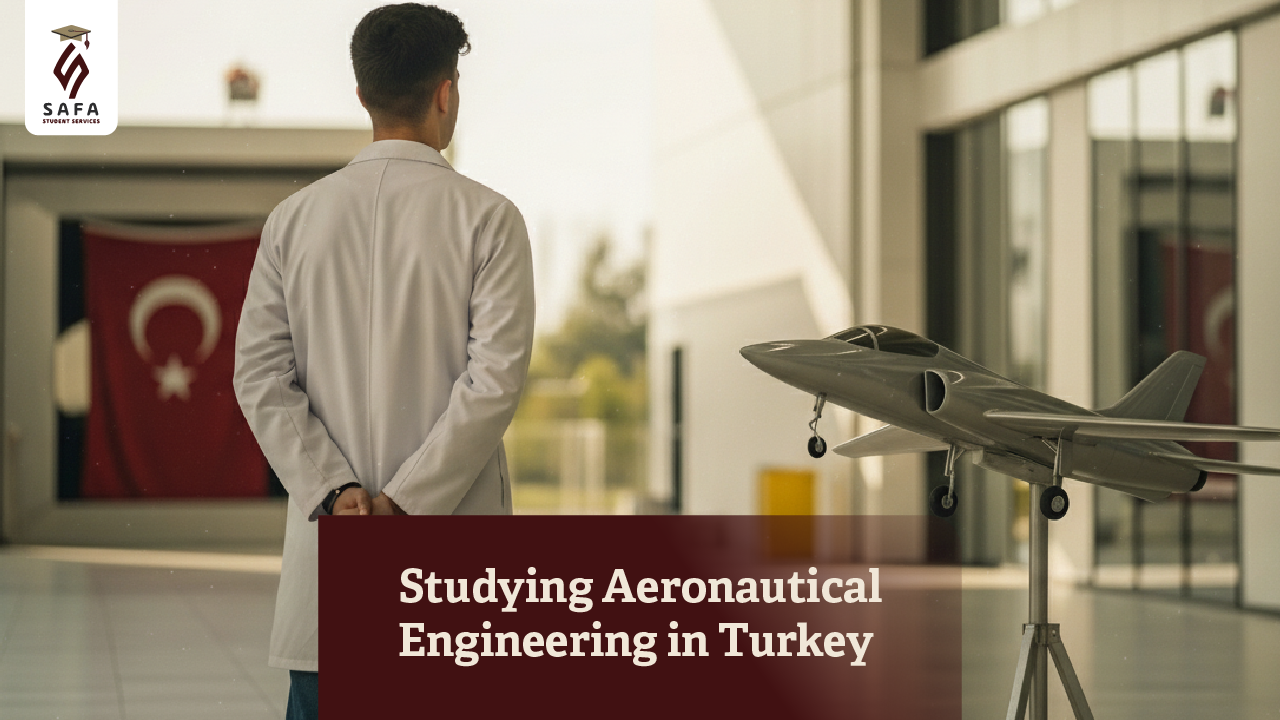
Studying Aeronautical Engineering in Turkey 2026: Soar into the skies of innovation

جدول المحتويات
Imagine yourself as part of a team designing the aircraft of the future, a cutting-edge space system, or developing technologies that enable aircraft to fly more efficiently and safely. This is the world of Aerospace Engineering, a field that combines a passion for flight with science and technology to create machines that soar in the skies above our planet and beyond. With the booming Turkish aerospace and defense industry, coupled with its strategic geographic location, Turkey has emerged as an attractive destination for ambitious students aspiring to study Aerospace Engineering in Turkey by 2025. This comprehensive article will provide you with a detailed guide covering everything you need to know about this exciting specialization, from its concept and academic aspects to admission requirements, costs, and career prospects.
What is aerospace engineering? And why is it important in 2025?
Aerospace engineering is a branch of engineering that deals with the design, development, testing, and maintenance of aircraft, spacecraft, rockets, and space systems. It can be broadly divided into two main areas:
- Aeronautical Engineering: It deals with the design, development, testing and maintenance of aircraft that operate within the Earth’s atmosphere (commercial aircraft, military aircraft, helicopters, drones).
- Astronautical Engineering: This branch deals with the design, development, testing, and maintenance of spacecraft, rockets, satellites, and space propulsion systems.
Modern universities usually combine these two fields into a single discipline known as “Aerospace Engineering” or “Space Engineering”.
The role of an aeronautical engineer encompasses many aspects, including:
- Aerodynamics: The study of how air interacts with flying objects to improve design and reduce drag.
- Propulsion Systems: Design and improvement of jet engines, rockets, and other propulsion systems.
- Aircraft structures: Analysis and design of structures to ensure strength and durability while maintaining low weight.
- Advanced materials: Using and developing new lightweight, high-strength materials.
- Avionics: Design and integration of electronic, navigation and communication systems.
- Control systems: Designing control systems that enable aircraft to fly stably and accurately.
- Safety and Quality: Ensuring that all designs and processes meet the highest standards of safety and quality.
In 2025 and beyond, aerospace engineering will become increasingly important due to the following global trends:
- Increased demand for air travel: As the global economy grows, the demand for large, efficient civilian aircraft is increasing.
- The evolution of drones: their increasing use in civilian and military applications is opening up new areas for design and innovation.
- New Space: The space sector is booming with the entry of private companies and the increasing demand for small satellites and commercial spaceflights.
- Sustainable aviation: Finding solutions to reduce the carbon footprint of aircraft, including alternative fuels, electric and hybrid aircraft.
- Artificial intelligence and machine learning: integrating these technologies into flight and control systems.
- Defense and security: The ongoing need to develop advanced aircraft and defense systems.
This continuous development makes aerospace engineering a dynamic field that provides promising and stable career opportunities, and enables its graduates to shape the future of air and space transport.
Advantages of studying Aerospace Engineering in Türkiye 2025
Türkiye offers a range of unique advantages that make it an excellent choice for studying aerospace engineering in 2025:
- The growing aerospace and defense industry: In recent years, Turkey has seen significant investment in its defense and aerospace industries, with companies such as Turkish Aerospace Industries (TAI), Roketsan, and Turkish Airlines. This provides a rich environment for practical training and employment.
- Quality of Engineering Education: Turkish universities, especially leading technical universities, are known for providing high-quality, internationally recognized engineering education. These universities adhere to European educational standards.
- Reasonable cost: Compared to leading countries in aerospace engineering (such as the United States or Western European countries), the costs of studying and living in Turkey are very reasonable, allowing students to obtain a high-quality education on a reasonable budget.
- Programs in English: Many Turkish private universities and some public universities offer aerospace engineering programs entirely in English, removing the language barrier for international students.
- Modern laboratories and facilities: Turkish universities invest in infrastructure, providing specialized laboratories in aerodynamics, aircraft structures, propulsion systems, and flight systems, enabling students to gain practical experience.
- Training opportunities and industrial cooperation: Universities maintain strong relationships with Turkish aviation and defense companies, providing practical training opportunities for students and enhancing their employment prospects after graduation.
- Strategic geographical location: Türkiye is a bridge between continents, providing students with a unique perspective on the global aviation industry and logistical challenges.
What will you study in the field of aerospace engineering?
A Bachelor of Science in Aeronautical Engineering (or Aerospace Engineering) program is typically 4 years long and covers a wide range of engineering and scientific topics:
- Basic materials in engineering and science:
- Advanced Mathematics (Calculus, Linear Algebra, Differential Equations).
- Physics (mechanics, electromagnetism, thermodynamics).
- Chemistry.
- Programming (such as MATLAB, Python).
- Engineering drawing and computer-aided design (CAD).
- Basic materials in aerospace engineering:
- Fluid dynamics and aerodynamics: the study of airflow around aircraft and lift and drag forces.
- Thermodynamics and propulsion: Principles of jet and rocket engines.
- Aircraft structures: Analysis and design of the structural parts of an aircraft.
- Solid mechanics and strength of materials: the behavior of materials under loads.
- Flight control systems: Designing control systems that enable an aircraft to fly.
- Avionics: Electronic systems, navigation and communications.
- Aircraft and spacecraft design: The process of designing aerial and space vehicles.
- Aircraft performance: Analysis of aircraft performance under different flight conditions.
- Flight testing and experimentation: Principles of aircraft testing.
- Advanced composite materials: The use of new materials in aircraft manufacturing.
- Vibrations and Dynamics: Analysis of aircraft vibrations.
- Aviation safety and maintenance: Aircraft maintenance principles and safety standards.
- Aerospace Engineering (for embedded programs): Satellite orbits, rocket design, space propulsion.
In addition to these materials, the program places a strong emphasis on practical projects, model design, simulation, and hands-on training in companies or laboratories to enhance applied skills.
Admission requirements for studying aerospace engineering in Türkiye 2025
Admission requirements for studying aerospace engineering at Turkish universities for international students vary depending on the type of university (public or private) and the language of instruction:
1. Public universities:
- High school diploma: Very high average (usually 85-90% or higher in the science track – mathematics, physics, chemistry, and biology). Competition for aerospace engineering positions at public universities is extremely high.
- Admission tests:
- The YÖS exam: This is the Turkish aptitude test for foreign students, required by most public universities. Very high YÖS scores are required to compete for engineering places.
- The SAT (SAT I) test: Some public universities accept the SAT test as an alternative to the YÖS, and require a minimum score of 1200-1400.
- Proficiency in the language:
- Turkish language: If the program is in Turkish, proof of language proficiency is required through the TOMER test at level C1, or the student can study a preparatory year for the Turkish language.
- English Language: If the program is in English, proof of proficiency is required through tests such as TOEFL (minimum 80-90) or IELTS (minimum 6.0-6.5), or the student can pass the university’s language placement test.
2. Private (endowment) universities:
- High school diploma: Good grade (may start from 65-70%, preferably higher for required engineering specializations). A science degree is preferred.
- Admission tests: Most private universities do not require YÖS or SAT tests as a basic requirement, and are satisfied with the high school GPA.
- Proficiency in the language:
- Turkish language: Same requirements as for state universities if the program is in Turkish.
- English language: Same requirements as government universities (TOEFL/IELTS) or passing the university’s language placement test.
- Additional documents: Some universities may require a letter of motivation, a resume, or a personal interview.
Important advice: You should always check the official website of the university you wish to apply to in order to find out the latest and most accurate admission requirements for the academic year 2025-2026, as these requirements change periodically.
Cost of studying aerospace engineering in Türkiye 2025
Türkiye offers a variety of options in terms of cost, making it suitable for different budgets:
1. Fees for public universities:
- Annual fees for studying aerospace engineering at Turkish state universities typically range from US$500 to US$3,500.
- These fees are very symbolic compared to the quality of education provided, and are considered a major competitive advantage.
- Programs taught in English may be slightly more expensive.
2. Private university fees:
- Annual fees for studying aerospace engineering at private (endowment) universities typically range from US$5,000 to US$15,000.
- Private universities with high rankings and prestigious academic reputations may have higher fees within this range.
- Many private universities offer options for paying fees in installments (annual or quarterly) to make things easier for students.
Cost of living in Türkiye 2025:
In addition to tuition fees, students must estimate living costs, which vary depending on the city and the student’s lifestyle.
- Average monthly cost: Typically ranges from US$350 to US$700.
- Accommodation:
- Government housing (KYK): about $50-$150 per month (cheapest option).
- Private accommodations: $150-$400 per month.
- Shared/private apartments: $200-$600 per month or more depending on location and city.
- Food: $100-$200 per month (you can save by cooking at home).
- Transportation: Approximately $20-$40 per month using a discounted student transportation card.
- Health insurance: Mandatory, about $100-$150 per year for government insurance (SGK).
- Personal expenses: $50-$150 per month (books, entertainment, communications).
Tip: Larger cities like Istanbul, Ankara, and Izmir have a higher cost of living compared to smaller cities..
Top universities for studying aerospace engineering in Türkiye 2025
Many Turkish universities offer excellent programs in aerospace engineering; here are some of the most prominent:
- Middle East Technical University (METU):
- It is considered one of the best Turkish universities in general, and in engineering in particular.
- Aerospace engineering programs are offered entirely in English and are renowned for their strong scientific research and high academic standards.
- Istanbul Technical University (İTÜ):
- One of the oldest and most prestigious technical universities in Türkiye, located in Istanbul.
- It is known for its excellence in engineering disciplines, including aerospace engineering.
- Programs are offered in English.
- Gaziantep University:
- A state university that offers outstanding engineering programs, including aerospace engineering, and is known for its strength in applied research.
- Ankara University:
- A prestigious public university in the capital, with strong engineering departments.
- Sabancı University:
- An innovative private university in Istanbul, offering strong engineering programs and focusing on multidisciplinary research.
- Bahçeşehir University:
- A popular private university in Istanbul, offering engineering programs in English, and distinguished by its industrial partnerships.
- Istanbul Gelişim University:
- A private university offering a variety of engineering programs, including aerospace engineering, and known for its modern facilities.
Career prospects for aerospace engineering graduates in Türkiye and worldwide in 2025
The future of an aeronautical engineer is very promising in 2025 and beyond, given the ongoing developments and increasing demand in this vital sector.
Potential areas of work:
- Design and development of aircraft and spacecraft: in aircraft manufacturing companies such as Turkish Aerospace Industries (TAI), Boeing, Airbus, Lockheed Martin.
- Propulsion systems: in engine manufacturing companies (such as Rolls-Royce, General Electric Aviation).
- Avionics: Design and integration of electronic and flight systems.
- Maintenance and repair: in major airlines (such as Turkish Airlines) and aircraft maintenance companies.
- Research and Development (R&D): In universities, research centers, or research and development departments in companies.
- Space and satellite manufacturing: in companies specializing in space technology.
- Drone companies: Design and development of drone applications.
- Space agencies: Working on national or international space programs.
- Project management: In complex projects related to aviation and defense.
- Engineering consulting: Providing expertise in the field of aviation.
- Defense sector: Design and development of military air systems.
In Türkiye, the defense and aerospace industries are one of the main pillars of the economy, and there are huge investments in this field.Companies liketoTAI and Roketsan offer excellent career opportunities for specialized engineers. Turkish Airlines, one of the world’s largest airlines, also provides opportunities in maintenance and operational management.
Tips for students wishing to study aerospace engineering in Türkiye in 2025:
- Enhance your skills in mathematics and physics: they are the backbone of aerospace engineering.
- Learning programming: Programming skills (MATLAB, Python, C++) are essential for simulation and analysis.
- Look for internship opportunities: Practical training in Turkish companies related to the aviation and defense industry will give you a competitive edge.
- Developing 3D design and modeling skills: Using CAD/CAE/CAM software is very important.
- Proficiency in English: Most advanced scientific resources in this field are in English, and working in this sector often requires international communication.
- Building a network of relationships: Attending conferences, workshops and industry events enables you to connect with experts.
- Continuous learning: The field of aviation is evolving rapidly. Be prepared for ongoing learning and specialization in new areas (such as electric aviation, autonomous vehicles).
- Flexibility and problem-solving skills: This field requires critical thinking and the ability to deal with complex challenges.
- Look for scholarship opportunities: Don’t hesitate to apply for the Turkish government scholarship or partial scholarships offered by private universities.
Studying Aerospace Engineering in Turkey in 2025 offers a unique opportunity for ambitious students with a passion for aviation and space, and a desire for technological innovation. With its prestigious universities, comprehensive programs, reasonable costs, and the growing demand for its graduates in the expanding defense and aerospace industry, Turkey is an excellent choice for launching a bright career in the world of innovation. Through careful planning and hard work, you can realize your dreams of designing and flying the machines of the future.
Latest News

Related Articles & News
Follow our latest articles

study petroleum engineering in turkey
Many international students seek to study petroleum engineering in Turkey, as it is considered one of the most vital and...
See More
esenyurt university tuition fees for international students
Tuition fees at Esenyurt University are a key factor attracting numerous international students seeking high-quality education at an affordable cost....
See More
Studying Mechanical Engineering in Turkey 2026: A Pillar of Industry and Innovation
In our modern world, from the engines of the cars that drive us daily to giant electricity-generating turbines and precision...
See More
Studying Artificial Intelligence Engineering in Turkey 2026: Towards a Future Led by Intelligent Machines
In a world experiencing an unprecedented technological revolution, Artificial Intelligence (AI) has become the driving force behind innovation in almost...
See More
Studying Dentistry in Turkey 2026: A Bright Smile for a Promising Future
In a world where health and beauty are increasingly important, dentistry is a medical profession that combines scientific precision with...
See More
Studying Biomedical Engineering in Türkiye 2025: A bridge linking engineering and health
In an era of rapid medical advancement, cutting-edge medical equipment has become the backbone of modern healthcare, from precision diagnostic...
See More