
Studying Anesthesiology in Turkey 2026: A vital profession at the heart of healthcare

جدول المحتويات
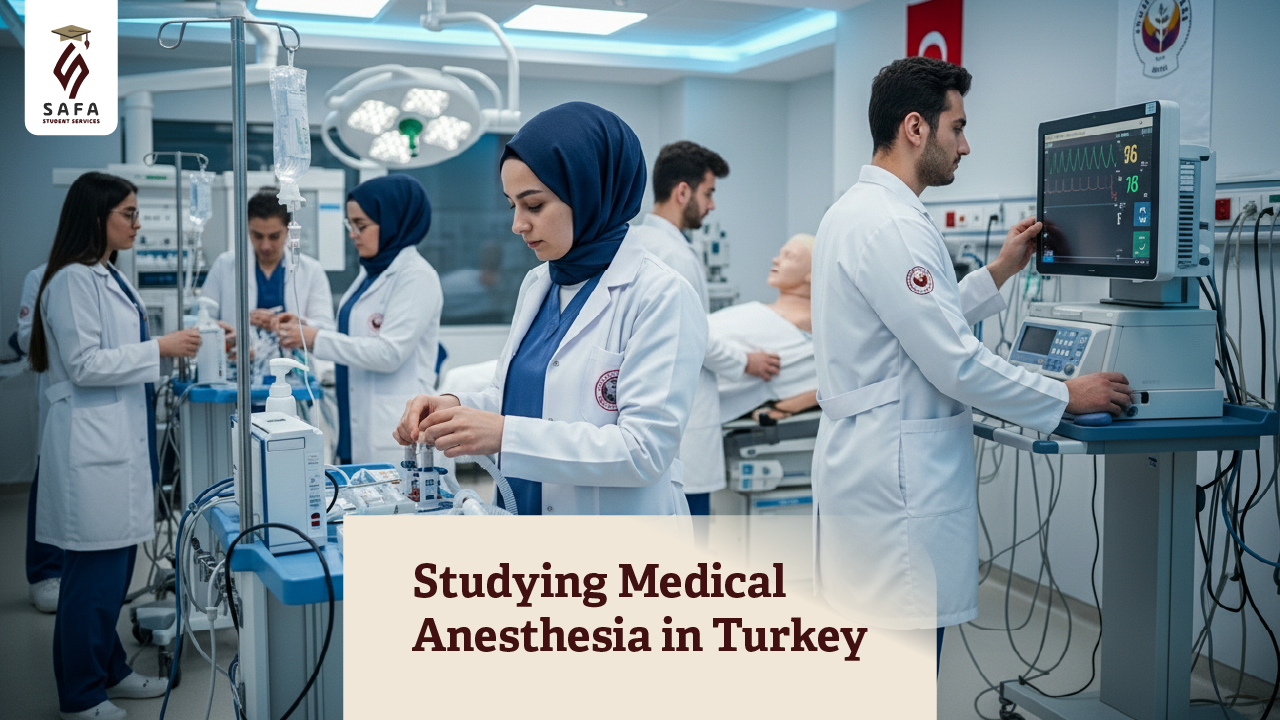
In every surgical procedure, and in many complex medical operations, the anesthesiologist plays a pivotal role, no less important than that of the surgeon. With a profound understanding of body physiology, medications, and emergency management, the anesthesiologist is a “guardian of life” during critical moments. With the rapid development of the Turkish healthcare sector and the increasing number of modern hospitals, Turkey has emerged as an attractive destination for ambitious international students aspiring to study medical anesthesiology in 2025. This comprehensive article will provide you with a detailed guide covering everything you need to know about this vital specialty, from its definition and academic aspects to admission requirements, costs, and career prospects.
What is the specialty of medical anesthesia? And why is it important in 2025?
Medical anesthesia is a branch of medicine concerned with preparing a patient for surgery or painful medical procedures by inducing a state of unconsciousness or pain relief, while preserving their vital functions.Anesthesia is divided into several typesMain:
- General Anesthesia: The patient loses consciousness completely and feels no pain.
- Local anesthesia: A small part of the body is numbed, and the patient remains awake.
- Regional Anesthesia: This numbs a larger area of the body (such as spinal anesthesia), and the patient remains awake or semi-awake.
- Sedation: The patient is given sedatives to relieve anxiety and pain, and remains partially conscious.
The role of the anesthesiologist is not limited to administering medication, but extends to include:
- Pre-anesthesia assessment: Evaluating the patient’s health status, medical history, medications they are taking, and selecting the best anesthesia plan.
- Monitoring during the procedure: Monitoring the patient’s vital signs (blood pressure, pulse, respiration, oxygen level) and ensuring their stability.
- Emergency handling: Managing any complications that may occur during anesthesia or surgery.
- Recovery after anesthesia: Monitoring the patient in the recovery room and ensuring that he or she has safely regained consciousness and vital functions.
- Pain management: whether it is acute pain after surgery or chronic pain.
In 2025 and beyond, the medical anesthesia specialty will become increasingly important due to the following global trends:
- Increased surgical procedures: As medicine advances and life expectancy increases, the number of surgical procedures requiring anesthesia is also increasing.
- Technological development: The use of modern anesthesia machines, advanced monitoring techniques, and precise drug delivery systems requires experts in medical technology.
- Precision and personalized medicine: Designing customized anesthesia plans for each patient based on their genetic and health status.
- Dealing with chronic disease cases: The increasing number of patients suffering from chronic diseases (such as heart disease and diabetes) makes the anesthesia process more complex and requires high expertise.
This continuous development makes anesthesia a vital field that provides stable and influential career opportunities, and enables its specialists to save lives and improve the quality of life of patients.
Advantages of studying medical anesthesia in Türkiye 2025
Türkiye offers a range of unique advantages that make it an excellent choice for studying medical anesthesia in 2025:
- Quality of Medical Education and Clinical Training: Turkish universities are known for providing high-quality medical education, particularly in their state-of-the-art medical schools. Anesthesiology programs focus on intensive clinical training in modern university hospitals, giving students invaluable practical experience.
- Advanced hospitals: Türkiye has a wide network of world-class public and private hospitals, which are an excellent training environment for anesthesia students.
- Affordable cost: Compared to many European and North American countries, the costs of studying and living in Türkiye are very reasonable, making it an excellent economical option for international students.
- English-language programs: Many medical schools in Turkish private universities and some public universities offer their programs entirely in English, making it easier for international students to study.
- Experienced professors: The academic staff in the Turkish anesthesia departments are distinguished by their extensive experience in scientific research and clinical practice.
- Multicultural environment: Türkiye’s attraction of students from all over the world creates a diverse educational environment, enriching the students’ academic and personal experience.
- Strategic location: Türkiye’s distinguished geographical location makes it easily accessible and provides opportunities to connect with health systems in Europe and Asia.
What will you study in the field of medical anesthesia?
Anesthesiology is usually a specialty within the study of human medicine, and then specialization in it is pursued as a residency program or postgraduate studies after graduating from medical school.
First: Studying human medicine (6 years):
During their years of studying human medicine, students will receive fundamental medical sciences such as:
- Anatomy
- Physiology
- Biochemistry
- Pharmacology
- Pathology
- Introduction to surgery, internal medicine, and other fields.
The curriculum will also include introductory courses in anesthesia and an introduction to its basics.
Second: Residency program (specialization in anesthesia and intensive care) (4-5 years after medical school):
After graduating from medical school and passing the specialty exam (TUS in Türkiye), the student enrolls in a residency program that focuses intensively on:
- Fundamentals of Anesthesia: Gas Physics, Respiratory Circuits, Anesthesia Machines, Principles of Patient Monitoring.
- Anesthesia pharmacology: A detailed study of the drugs used in anesthesia (general and local anesthetics, muscle relaxants, analgesics).
- Applied physiology: Understanding how anesthesia affects different body systems (cardiovascular, respiratory, kidneys, liver).
- Anesthesia techniques: general anesthesia, regional anesthesia (epidural, subarachnoid, nerve block), local anesthesia.
- Airway management: dealing with airway difficulties, tracheal intubation, mechanical ventilation.
- Critical care medicine: Management of critically ill patients in intensive care units.
- Pain management: Treatment of acute and chronic pain, and post-operative pain relief techniques.
- Specialized anesthesia: pediatric anesthesia, cardiac anesthesia, neurological anesthesia, obstetric anesthesia, organ transplant anesthesia.
- Safety principles in anesthesia: risk management, dealing with complications, patient safety.
- Scientific research: Participation in scientific research and projects in the field of anesthesia.
Clinical training is the backbone of the residency program, with residents spending most of their time in operating rooms and intensive care units, under the supervision of experienced anesthesiologists.
Admission requirements for studying medical anesthesia in Türkiye 2025
The admission requirements differ significantly between the undergraduate stage (studying human medicine) and the specialization stage (residency in anesthesia).
1. To enroll in the Faculty of Human Medicine (as a prelude to specializing in anesthesia):
- High school diploma: with a very high average (usually no less than 90% or above in the science section – subjects of mathematics, physics, chemistry, and biology).
- Admission tests:
- The YÖS exam: This is the Turkish aptitude test for foreign students, required by most public universities. Very high YÖS scores are required to compete for places in medical school.
- The SAT (SAT I) test: Some public universities accept the SAT test as an alternative to the YÖS, and require a minimum score of 1300-1400.
- Medical entrance exam for private universities (if applicable): Some private universities may conduct their own entrance exams.
- Proficiency in the language:
- Turkish language: If the program is in Turkish, proof of language proficiency is required through the TOMER test at level C1, or the student can study a preparatory year for the Turkish language.
- English Language: If the program is in English, proof of proficiency is required through tests such as TOEFL (minimum 85-90) or IELTS (minimum 6.5-7.0), or the student can pass the university’s language placement test.
- Additional documents: Some universities may require a letter of motivation, letters of recommendation, or a personal interview.
2. To enroll in the Anesthesia Residency Program (after graduating from medical school):
- Human Medicine Certificate: Recognized by the Turkish Higher Education Council (YÖK).
- The Medical Specialty Examination (TUS): This is a centralized exam administered in Türkiye to select physicians for specialty programs. A very high score on the TUS is required for admission to the specialty of Anesthesiology, as it is a highly sought-after specialty.
- Proficiency in Turkish: Proficiency in Turkish is essential for clinical training and communication with patients and colleagues.
- Turkish citizenship or residence permit: Priority is given to Turkish citizens, and there may be a limited number of seats for foreigners under special conditions.
Important note: Admission to Turkish public medical schools is highly competitive. Private universities offer easier admission opportunities but at higher fees. Residency (specialization) requires successfully passing the TUS exam.
Cost of studying medical anesthesia in Türkiye 2025
Costs vary significantly between public and private universities.
1. Tuition fees for studying human medicine (Bachelor’s degree) in Türkiye:
- Public universities: Annual tuition fees for studying human medicine typically range from US$1,000 to US$7,000. These fees are very reasonable compared to the quality of education provided.
- Private universities: Annual fees for studying human medicine at private universities typically range from US$12,000 to US$25,000 or more.
2. Cost of the residency (specialty) program in anesthesia:
- In government universities and teaching hospitals affiliated with the Ministry of Health, the residency program is considered free, and the resident physician is even paid a monthly salary (albeit a small one) because he provides medical services.
- There may be some paid master’s programs in certain anesthesia-related specialties, but formal medical specialization is within the residency system.
Cost of living in Türkiye 2025:
- Average monthly cost: Typically ranges from US$350 to US$700.
- Accommodation:
- Government housing (KYK): about $50-$150 per month (cheapest option).
- Private accommodations: $150-$400 per month.
- Shared/private apartments: $200-$600 per month or more depending on location and city.
- Food: $100-$200 per month.
- Transportation: Approximately $20-$40 per month using a discounted student transportation card.
- Health insurance: Mandatory, about $100-$150 per year for government insurance (SGK).
- Personal expenses: $50-$150 per month.
Tip: Large cities like Istanbul, Ankara and Izmir have a higher cost of living compared to smaller cities.
Best universities to study medical anesthesia in Türkiye 2025
Anesthesiology, as a medical specialty, is primarily studied in medical schools and then as a residency program. Here are some of the best medical schools in Türkiye that offer excellent training in anesthesiology:
- Hacettepe University: Located in Ankara, it is one of the best medical colleges in Türkiye, and has a very strong and renowned Department of Anesthesia and Intensive Care, known for its scientific research and clinical training.
- Istanbul University – Cerrahpaşa Faculty of Medicine: One of the oldest and most prestigious medical schools in Türkiye, offering excellent clinical training in anesthesia.
- Istanbul University – Istanbul Faculty of Medicine: Another prestigious medical school affiliated with Istanbul University, known for the strength of its clinical and research programs.
- Ege University: Located in Izmir, it is one of the leading state universities and has a strong medical school and an outstanding anesthesiology department.
- Ankara University: A prestigious medical school in the capital, offering strong medical programs and good clinical training in various specialties.
- Koç University: A prestigious private university in Istanbul, with a modern medical school equipped with the latest technologies, offering its programs in English, and having a distinguished Department of Anesthesia and Intensive Care.
- Sabancı University: A private university in Istanbul, offering strong medical programs within an advanced academic and research framework.
- Istanbul Medipol University: A rapidly growing private university with very modern university hospitals equipped with the latest technologies, making it an excellent environment for training anesthesiologists.
Career prospects for medical anesthesia graduates in Türkiye and worldwide 2025
Anesthesia is a vital and essential specialty in any health system, and therefore its career prospects are excellent and stable.
Potential areas of work:
- Government and private hospitals: Working as an anesthesiologist in operating rooms, intensive care units, and emergency rooms.
- Day Surgery Centers: Anesthesia for minor surgical procedures that do not require hospitalization.
- Pain Management Units: Specializing in the treatment of acute and chronic pain in clinics or hospitals.
- Specialized clinics: such as dental clinics that require anesthesia, or cosmetic clinics.
- Academic and research work: Working as a university professor, researcher, or trainer of future doctors in medical schools.
- Pharmaceutical and medical supply companies: in the research and development or marketing departments for products related to anesthesia and intensive care.
- Medical emergencies: as part of emergency response teams.
In Turkey, the healthcare sector is experiencing significant growth and investment in modern hospitals, creating a continuous demand for qualified anesthesiologists. Turkish medical degrees are internationally recognized, enabling graduates to pursue careers or postgraduate studies in other countries after fulfilling equivalency and licensing requirements.
Tips to boost your career opportunities:
- Academic and clinical excellence: Anesthesia is a precise specialty that requires high accuracy and skill.
- Gaining experience in subspecialties: such as cardiac anesthesia, pediatric anesthesia, or pain management, will increase your specialization and demand.
- Learning Turkish: Mastering the Turkish language is crucial for effective communication with patients and medical teams.
- Participating in research: Your participation in research and conferences enhances your academic and professional profile.
- Developing soft skills: communication skills, teamwork, decision-making under pressure, and handling critical situations.
- Continuous training: Attending workshops and advanced training courses to keep up with the latest technologies and practices in anesthesia.
Studying Anesthesiology in Turkey in 2025 offers an exceptional opportunity for ambitious students seeking a noble and impactful career at the heart of healthcare. With a robust medical education system, modern hospitals, and reasonable costs (especially at public universities and after residency), Turkey is an ideal destination to acquire the knowledge and skills necessary to become a successful anesthesiologist. If you are ready to take on this long and rewarding educational journey, Turkey provides the environment and support you need to achieve your ambitions.
Latest News

Related Articles & News
Follow our latest articles

study petroleum engineering in turkey
Many international students seek to study petroleum engineering in Turkey, as it is considered one of the most vital and...
See More
esenyurt university tuition fees for international students
Tuition fees at Esenyurt University are a key factor attracting numerous international students seeking high-quality education at an affordable cost....
See More
Studying Mechanical Engineering in Turkey 2026: A Pillar of Industry and Innovation
In our modern world, from the engines of the cars that drive us daily to giant electricity-generating turbines and precision...
See More
Studying Artificial Intelligence Engineering in Turkey 2026: Towards a Future Led by Intelligent Machines
In a world experiencing an unprecedented technological revolution, Artificial Intelligence (AI) has become the driving force behind innovation in almost...
See More
Studying Dentistry in Turkey 2026: A Bright Smile for a Promising Future
In a world where health and beauty are increasingly important, dentistry is a medical profession that combines scientific precision with...
See More
Studying Aeronautical Engineering in Turkey 2026: Soar into the skies of innovation
Imagine yourself as part of a team designing the aircraft of the future, a cutting-edge space system, or developing technologies...
See More