
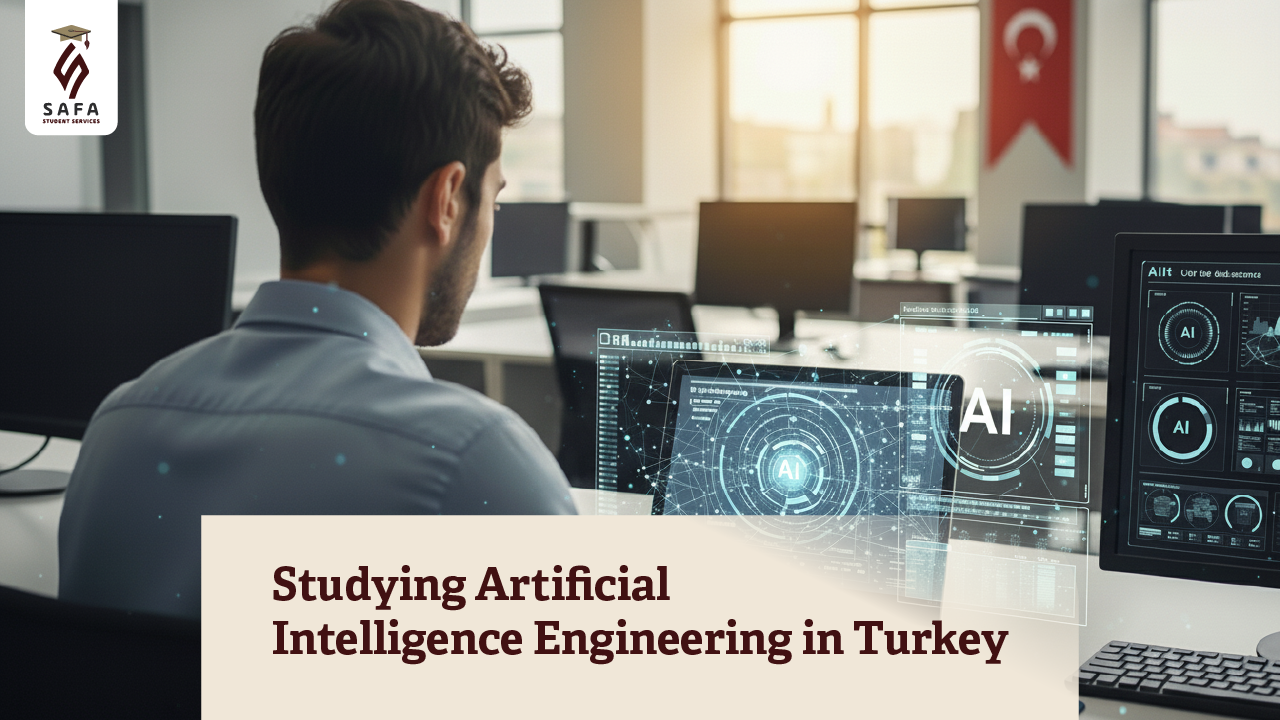
Studying Artificial Intelligence Engineering in Turkey 2026: Towards a Future Led by Intelligent Machines

جدول المحتويات
In a world experiencing an unprecedented technological revolution, Artificial Intelligence (AI) has become the driving force behind innovation in almost every aspect of our lives. From self-driving cars and industrial robots to voice assistants and medical diagnostic systems, AI is transforming how we work and interact with the world. With the rapid development of the technology and scientific research sector in Turkey, the country has emerged as an attractive destination for ambitious international students aspiring to study AI engineering in Turkey by 2025. This comprehensive article will provide you with a detailed guide covering everything you need to know about this revolutionary field, from its concept and academic aspects to admission requirements, costs, and career prospects.
What is artificial intelligence engineering? And why is it important in 2025?
Artificial intelligence engineering is a multidisciplinary engineering discipline that focuses on the design, development, and implementation of artificial intelligence systems. This field encompasses not only understanding the theoretical concepts of artificial intelligence but also the practical and applied aspects of building intelligent solutions that mimic human capabilities in thinking, learning, problem-solving, and decision-making.
The work of an artificial intelligence engineer encompasses multiple aspects, including:
- Machine Learning: Developing algorithms that enable systems to learn from data without explicit programming.
- Deep Learning: A branch of machine learning that relies on complex artificial neural networks to process massive amounts of data.
- Natural Language Processing (NLP): Enabling machines to understand, interpret, and generate human language.
- Computer Vision: Enabling machines to “see” and interpret visual information from images and videos.
- Robotics: Designing and programming intelligent robots that interact with their environment.
- Expert Systems: Building systems that mimic the ability of human experts to make decisions in specific areas.
- Big Data Analytics: Using artificial intelligence techniques to analyze massive datasets and extract insights from them.
In 2025 and beyond, the importance of artificial intelligence engineering will increase significantly due to the following global trends:
- Comprehensive automation and digitalization: Industries are transforming towards automation and intelligent process control.
- Leaps in healthcare: development of more accurate diagnostic systems, personalized medicines, and surgical robots.
- Self-driving vehicles: The ongoing evolution of car and drone technology.
- Improved customer service: Using chatbots and voice assistants to provide a better customer experience.
- Cybersecurity: Using artificial intelligence to detect and combat security threats.
- Smart cities: Integrating artificial intelligence into city infrastructure to improve efficiency and sustainability.
- Predictive analytics: Using artificial intelligence to predict future trends in business, the economy, and even natural phenomena.
This continuous development makes artificial intelligence engineering a vital field that provides countless job opportunities, and enables its graduates to lead the way in innovation in our present and future era.
Advantages of studying Artificial Intelligence Engineering in Türkiye 2025
Türkiye offers a range of unique advantages that make it an excellent choice for studying artificial intelligence engineering in 2025:
- Quality of Engineering and Technology Education: Turkish universities, especially prestigious private and technical universities, are known for providing high-quality engineering education that is internationally recognized. Many of their programs hold international accreditations.
- Increased investment in technology and research: The Turkish government and universities are focusing on investing in advanced technology fields, including artificial intelligence, by establishing specialized research centers and supporting innovative projects.
- Affordable cost: Compared to many leading AI countries (such as the United States or Western European countries), the costs of studying and living in Turkey are very reasonable, allowing students to obtain a high-quality education on a budget.
- Programs in English: Many private Turkish universities and some public universities offer artificial intelligence engineering programs (or related disciplines such as computer engineering with an AI specialization) entirely in English, removing the language barrier for international students.
- Modern laboratories and facilities: Turkish universities are investing in infrastructure, providing advanced computer laboratories, data centers, and high-performance computing resources essential for the study and application of artificial intelligence.
- Research and development opportunities: Universities encourage students to participate in research projects with professors, giving them practical experience in applying artificial intelligence algorithms and solving real problems.
- Collaboration with industry: Universities are developing growing relationships with technology companies and startups in Türkiye, providing opportunities for practical training and building professional relationships.
- A young and dynamic environment: Türkiye is experiencing a growing youth population and increasing interest in technology and innovation, creating a stimulating environment for students in the field of artificial intelligence.
What will you study in the field of Artificial Intelligence Engineering?
A Bachelor of Science in Artificial Intelligence Engineering program is typically 4 years long and covers a mix of computer science, mathematics, and statistics, as well as specialized concepts in artificial intelligence:
- Core subjects in computer science:
- Introduction to programming and data structures (using languages such as Python, Java, C++).
- Algorithms.
- Software engineering.
- Databases.
- Computer networks.
- Operating systems.
- Core subjects in mathematics and statistics:
- Linear algebra.
- Differential and integral calculus.
- Probability and statistics.
- Discrete mathematics.
- Specialized materials on artificial intelligence:
- Introduction to Artificial Intelligence.
- Machine Learning: Classification and Regression Algorithms, Clustering, Dimensional Reduction.
- Deep Learning: Neural Networks, Convolutional Networks (CNNs), Recurrent Networks (RNNs).
- Natural Language Processing (NLP): Language comprehension, emotion analysis, machine translation.
- Computer Vision: Image processing, pattern recognition, facial recognition.
- Robots and autonomous systems.
- Fuzzy logic and neural networks.
- Artificial intelligence agents and multi-agent systems.
- Reinforcement Learning.
- The ethics and responsibilities of artificial intelligence.
In addition to these materials, the program places a strong emphasis on practical projects, building AI models, using specialized libraries and software frameworks (such as TensorFlow, PyTorch), and participating in graduation projects that enable students to apply theoretical knowledge to real-world challenges.
Admission requirements for studying artificial intelligence engineering in Türkiye 2025
Admission requirements for studying artificial intelligence engineering at Turkish universities for international students vary depending on the type of university (public or private) and the language of instruction:
1. Public universities:
- High school diploma: Very high average (usually no less than 85-90% or higher in the science track – subjects include mathematics, physics, chemistry, and computer science if applicable). Competition for engineering positions, especially in modern specializations such as artificial intelligence, is very high.
- Admission tests:
- The YÖS exam: This is the Turkish aptitude test for foreign students, required by most public universities. Very high YÖS scores are required to compete for engineering places.
- The SAT (SAT I) test: Some public universities accept the SAT test as an alternative to the YÖS, and require a minimum score of 1200-1400.
- Proficiency in the language:
- Turkish language: If the program is in Turkish, proof of language proficiency is required through the TOMER test at level C1, or the student can study a preparatory year for the Turkish language.
- English Language: If the program is in English, proof of proficiency is required through tests such as TOEFL (minimum 80-90) or IELTS (minimum 6.0-6.5), or the student can pass the university’s language placement test.
2. Private (endowment) universities:
- High school diploma: Good grade (may start from 65-70%, preferably higher for required engineering specializations). A science degree is preferred.
- Admission tests: Most private universities do not require YÖS or SAT tests as a basic requirement, and are satisfied with the high school GPA.
- Proficiency in the language:
- Turkish language: Same requirements as for state universities if the program is in Turkish.
- English language: Same requirements as government universities (TOEFL/IELTS) or passing the university’s language placement test.
- Additional documents: Some universities may require a letter of motivation, a resume, or a personal interview.
Important advice: You should always check the official website of the university you wish to apply to in order to find out the latest and most accurate admission requirements for the academic year 2025-2026, as these requirements change periodically.
Cost of studying Artificial Intelligence Engineering in Türkiye 2025
Türkiye offers a variety of options in terms of cost, making it suitable for different budgets:
1. Fees for public universities:
- Annual fees for studying Artificial Intelligence Engineering (or Computer Engineering with an AI major) at Turkish state universities typically range from US$500 to US$4000.
- These fees are very symbolic compared to the quality of education provided, and are considered a major competitive advantage.
- Programs taught in English may be slightly more expensive.
2. Private university fees:
- Annual fees for studying artificial intelligence engineering at private (endowment) universities typically range from US$6,000 to US$15,000.
- Private universities with high rankings and prestigious academic reputations may have higher fees within this range.
- Many private universities offer options for paying fees in installments (annual or semester-based) to make things easier for students.
Cost of living in Türkiye 2025:
In addition to tuition fees, students must estimate living costs, which vary depending on the city and the student’s lifestyle.
- Average monthly cost: Typically ranges from US$350 to US$700.
- Accommodation:
- Government housing (KYK): about $50-$150 per month (cheapest option).
- Private accommodations: $150-$400 per month.
- Shared/private apartments: $200-$600 per month or more depending on location and city.
- Food: $100-$200 per month (you can save by cooking at home).
- Transportation: Approximately $20-$40 per month using a discounted student transportation card.
- Health insurance: Mandatory, about $100-$150 per year for government insurance (SGK).
- Personal expenses: $50-$150 per month (books, entertainment, communications).
Tip: Large cities like Istanbul, Ankara and Izmir have a higher cost of living compared to smaller cities.
Top universities for studying artificial intelligence engineering in Türkiye 2025
Many Turkish universities offer excellent programs in artificial intelligence engineering or computer engineering programs with a specialization in artificial intelligence. Here are some of the most prominent:
- Middle East Technical University (METU):
- It is considered one of the best Turkish universities in general, and in engineering and computer science in particular.
- It offers strong programs in computer science, electrical and electronic engineering with a focus on artificial intelligence.
- It is known for its strong scientific research and high academic level of its students, and offers programs in English.
- Bilkent University:
- A prestigious private university in Ankara, offering high-quality education in English.
- It has strong departments in computer engineering and electrical and electronics engineering with advanced courses in artificial intelligence and machine learning.
- It is known for its focus on scientific research and modern facilities.
- Koç University:
- A leading private university in Istanbul, distinguished by its English-language programs and rigorous academic standards in engineering and computer science.
- It has active research centers in artificial intelligence and robotics.
- Sabancı University:
- An innovative private university in Istanbul, offering strong engineering programs and focusing on multidisciplinary research.
- It is known for its academic flexibility and the strength of its computer science departments.
- Istanbul Technical University (İTÜ):
- One of the oldest and most prestigious technical universities in Türkiye, it has strong departments in computer engineering and control engineering.
- It has begun offering specialized artificial intelligence programs or intensive tracks within its existing programs.
- Bahçeşehir University:
- A popular private university in Istanbul, offering engineering programs in English, with a special interest in artificial intelligence and data science.
- Izmir University of Economics:
- Programs in computer engineering and software engineering are offered with tracks in artificial intelligence, and are known for keeping up with industry requirements.
- Istanbul University:
- In addition to their traditional specializations, some computer science and applied mathematics departments have begun offering programs or courses in artificial intelligence.
Future career prospects for AI engineering graduates in Türkiye and the world in 2025
The future of artificial intelligence engineers is very bright and the demand for them is steadily increasing in 2025 and beyond, as it is one of the fastest-growing and most influential disciplines globally.
Potential areas of work:
- Machine Learning Engineer: Design, develop and implement machine learning systems in various industries.
- Deep Learning Engineer: A specialist in building and training complex neural networks for advanced applications.
- Computer Vision Engineer: Works on developing systems that enable machines to understand and analyze images and video (e.g., in self-driving cars, security, healthcare).
- Natural Language Processing Engineer (NLP Engineer): Designing systems that process and understand human language (e.g., in chatbots, machine translation, text analysis).
- Artificial Intelligence (AI) Researcher: In universities, research centers, or research and development departments of large companies.
- Robotics Engineer: Designing and programming intelligent robots for industry, medicine, or everyday uses.
- Data Scientist: Analyzing large datasets using artificial intelligence techniques to extract insights.
- Intelligent Software Engineer: Integrating artificial intelligence capabilities into software applications.
- AI QA Engineer: Testing and evaluating the performance of artificial intelligence systems.
- Artificial Intelligence Consultant: Advising companies on how to implement AI solutions.
In Turkey, the technology sector is experiencing rapid growth, with an increasing number of startups and a growing interest in applying artificial intelligence in fields such as e-commerce, banking, telecommunications, and healthcare. This is creating a dynamic job market for AI engineering graduates.
Tips for students wishing to study Artificial Intelligence Engineering in Türkiye in 2025:
- Enhance your math and programming skills: they are the backbone of this major. Focus on linear algebra, statistics, and languages like Python.
- Build personal projects (Portfolio): Start by building small projects in the field of machine learning or deep learning to showcase your skills.
- Participating in Kaggle and data competitions: These platforms provide excellent opportunities to apply what you learn and develop your skills.
- Continuous learning and keeping up with developments: The field of artificial intelligence is changing rapidly. Always stay informed about the latest research and tools.
- Practical training (Internships): Look for training opportunities in Turkish or international companies to gain field experience.
- Developing problem-solving skills: Artificial intelligence is about solving complex problems.
- Focus on soft skills: Communication skills, teamwork, and creative thinking are very important.
- Proficiency in English is absolutely essential for accessing scientific resources, global technical communities, and international job opportunities.
- Build a network: Connect with your professors, colleagues, and professionals in the field. Attend relevant conferences and events.
- Understanding ethics and responsibilities: Because artificial intelligence affects society, understanding the ethical and legal aspects is crucial.
Studying Artificial Intelligence Engineering in Turkey in 2025 offers a golden opportunity for students passionate about technology and eager to shape a future where human intelligence is enhanced by artificial intelligence. With its prestigious universities, comprehensive programs, reasonable costs, and the growing demand for its graduates in a rapidly expanding technology sector, Turkey is an excellent choice for investing in your education in this revolutionary field. Through careful planning and hard work, you can build a successful and fulfilling career at the forefront of technological innovation.
Latest News

Related Articles & News
Follow our latest articles

study petroleum engineering in turkey
Many international students seek to study petroleum engineering in Turkey, as it is considered one of the most vital and...
See More
esenyurt university tuition fees for international students
Tuition fees at Esenyurt University are a key factor attracting numerous international students seeking high-quality education at an affordable cost....
See More
Studying Mechanical Engineering in Turkey 2026: A Pillar of Industry and Innovation
In our modern world, from the engines of the cars that drive us daily to giant electricity-generating turbines and precision...
See More
Studying Dentistry in Turkey 2026: A Bright Smile for a Promising Future
In a world where health and beauty are increasingly important, dentistry is a medical profession that combines scientific precision with...
See More
Studying Aeronautical Engineering in Turkey 2026: Soar into the skies of innovation
Imagine yourself as part of a team designing the aircraft of the future, a cutting-edge space system, or developing technologies...
See More
Studying Biomedical Engineering in Türkiye 2025: A bridge linking engineering and health
In an era of rapid medical advancement, cutting-edge medical equipment has become the backbone of modern healthcare, from precision diagnostic...
See More