
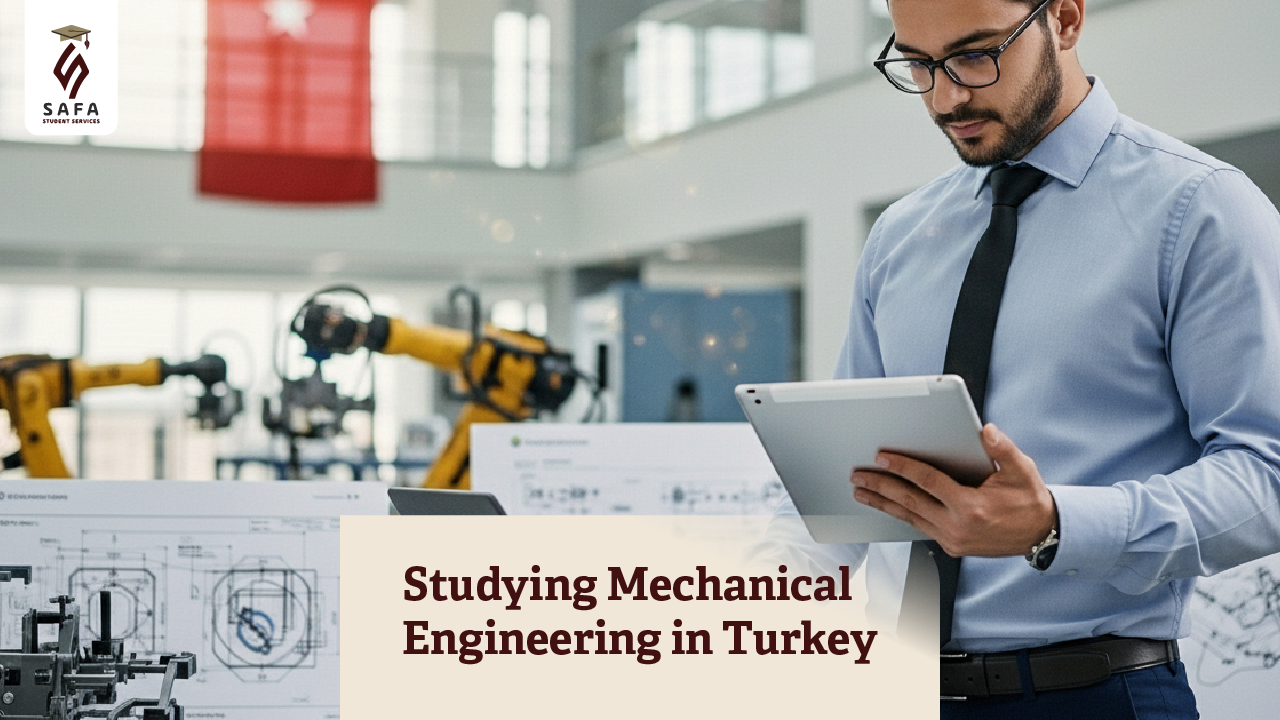
Studying Mechanical Engineering in Turkey 2026: A Pillar of Industry and Innovation

جدول المحتويات
In our modern world, from the engines of the cars that drive us daily to giant electricity-generating turbines and precision industrial robots, mechanical engineering is the driving force behind the design, development, and operation of everything that moves and works. It is the “mother of all engineering disciplines,” combining the fundamental principles of physics, mathematics, and materials science to design, analyze, and manufacture mechanical systems. With Turkey’s rapid industrial and technological development across various sectors, including automotive, energy, defense, and aerospace, it has emerged as an attractive destination for ambitious international students aspiring to study mechanical engineering in Turkey by 2025. This comprehensive article will provide you with a detailed guide covering everything you need to know about this essential field, from its definition and academic aspects to admission requirements, costs, and career prospects.
What is mechanical engineering? And why is it important in 2025?
Mechanical engineering is one of the oldest and broadest branches of engineering, applying the principles of engineering, design, analysis, manufacturing, and maintenance to mechanical systems. A mechanical engineer can work on anything from the smallest micro-components to the largest and most complex machines.
The work of a mechanical engineer encompasses multiple aspects, including:
- Design and Development: Design and development of new mechanical products and systems, such as motors, robots, pumps, turbines, and heating and cooling (HVAC) systems.
- Analysis and testing: Analyzing the performance of mechanical systems, testing materials, and conducting simulations to ensure efficiency and safety.
- Manufacturing and Production: Supervising manufacturing processes, improving production lines, and ensuring product quality.
- Maintenance and operation: Maintaining and repairing machinery and equipment, and ensuring their smooth operation.
- Research and Development: Discovering new ways to solve engineering problems, and developing new technologies and materials.
In 2025 and beyond, the importance of mechanical engineering will increase significantly due to the following global trends:
- The Fourth Industrial Revolution (Industry 4.0): Integrating mechanical systems with artificial intelligence, the Internet of Things (IoT), robotics, and 3D printing to achieve greater automation and intelligence in factories.
- Renewable energy: Designing and developing more efficient solar, wind and hydroelectric power systems.
- Electric cars and self-driving vehicles: The need for mechanical engineers to design the propulsion, cooling, and chassis systems for these future vehicles.
- Space and Defense: Development of rocket propulsion systems, spacecraft structures, and advanced control systems.
- Additive Manufacturing (3D Printing): Developing new materials and technologies for 3D printing.
- Environmental challenges: Designing more energy-efficient mechanical systems and reducing emissions.
- Biomedicine: Design of medical devices, prosthetics, and robotic surgical systems.
This continuous development makes mechanical engineering a dynamic field that provides promising and stable career opportunities, and enables its graduates to lead the way in innovation across various industries.
Advantages of studying mechanical engineering in Türkiye 2025
Türkiye offers a range of unique advantages that make it an excellent choice for studying mechanical engineering in 2025:
- Prestigious quality of engineering education: Turkish universities, especially leading technical universities, are known for providing high-quality, internationally recognized engineering education. Many of their programs hold international accreditations (such as ABET for some universities) and adhere to the European Bologna Process standards.
- A growing industrial base: Turkey has experienced significant growth in its industrial sectors, such as automotive (Ford, Fiat, Renault, and Toyota all have factories in Turkey), machinery, energy, defense, and aerospace. This provides a rich environment for practical training and employment.
- Affordable cost: Compared to many European and North American countries, the costs of studying and living in Türkiye are very reasonable, allowing students to obtain a high-quality education on a budget.
- English-language programs: Many Turkish private universities and some public universities offer mechanical engineering programs entirely in English, removing the language barrier for international students and making it easier to understand specialized engineering terminology.
- Modern laboratories and facilities: Turkish universities invest in infrastructure, providing specialized laboratories in thermodynamics, fluid mechanics, materials, manufacturing, robotics, and control systems, enabling students to gain practical experience.
- Training and industrial cooperation opportunities: Universities maintain strong relationships with Turkish industrial companies, providing practical training opportunities for students and enhancing their employment prospects after graduation.
- Strategic location: Türkiye’s outstanding geographical location makes it easily accessible and provides students with a unique perspective on regional and global industries.
- Research and development opportunities: Universities encourage students to participate in research projects with professors, giving them practical experience in applying engineering principles and solving real problems.
What will you study in the field of mechanical engineering?
A Bachelor of Science in Mechanical Engineering program is typically 4 years long and covers a wide range of engineering and scientific topics:
- Basic materials in engineering and science:
- Advanced Mathematics (Calculus, Linear Algebra, Differential Equations).
- Physics (mechanics, electromagnetism, thermodynamics).
- General chemistry.
- Programming and data structures (using languages such as MATLAB, Python, C++).
- Engineering drawing and computer-aided design (CAD).
- Introduction to Electrical and Electronic Engineering.
- Basic materials in mechanical engineering:
- Mechanics of Materials (Strength of Materials): The study of the behavior of materials under loads and forces.
- Dynamics: The study of the motion of bodies and the forces that cause it.
- Thermodynamics: The study of energy transformations and their applications in engines and power systems.
- Fluid Mechanics: The study of the behavior of fluids and gases and their applications (pumps, turbines, aerodynamics).
- Heat Transfer: A study of heat transfer methods and their applications in cooling and heating systems.
- Mechanical Design: Principles of designing mechanical parts and machines.
- Mechanical Vibrations: Analysis of vibrations in mechanical systems and how to control them.
- Theory of Machines and Mechanics: The study of how complex machines work.
- Materials Science and Engineering: Understanding the properties of materials and selecting the most suitable ones for different applications.
- Automatic Control Systems: Designing systems that control the behavior of machines.
- Manufacturing Processes: A study of the various manufacturing processes (casting, forming, machining, welding).
- Robotics and Mechatronics: An introduction to the design of robots and systems that combine mechanics, electronics, and control.
In addition to these materials, the program places a strong emphasis on practical projects, model design, simulation (using software such as SolidWorks, AutoCAD, ANSYS), and hands-on training in companies or laboratories to enhance applied skills.
Admission requirements for studying mechanical engineering in Türkiye 2025
Admission requirements for studying mechanical engineering at Turkish universities for international students vary depending on the type of university (public or private) and the language of instruction:
1. Public universities:
- High school diploma: Very high average (usually 80-90% or higher in the science track – mathematics, physics, chemistry). Competition for engineering positions at public universities is extremely high.
- Admission tests:
- The YÖS exam: This is the Turkish aptitude test for foreign students, required by most public universities. Very high YÖS scores are required to compete for engineering places.
- The SAT (SAT I) test: Some public universities accept the SAT test as an alternative to the YÖS, and require a minimum score of 1100-1300.
- Proficiency in the language:
- Turkish language: If the program is in Turkish, proof of language proficiency is required through the TOMER test at level C1, or the student can study a preparatory year for the Turkish language.
- English Language: If the program is in English, proof of proficiency is required through tests such as TOEFL (minimum 75-85) or IELTS (minimum 6.0-6.5), or the student can pass the university’s language placement test.
2. Private (endowment) universities:
- High school diploma: Good grade (may start from 60-70%, preferably higher for required engineering specializations). PreferredAcademic certificate.
- Admission tests: Most private universities do not require YÖS or SAT tests as a basic requirement, and are satisfied with the high school GPA.
- Proficiency in the language:
- Turkish language: Same requirements as for state universities if the program is in Turkish.
- English language: Same requirements as government universities (TOEFL/IELTS) or passing the university’s language placement test.
- Additional documents: Some universities may require a letter of motivation, a resume, or a personal interview.
Important tip: Always check the official website of the university you wish to apply to for the latest and most accurate information.Admission requirements for the academic year 2025-2026, as these requirements change periodically.
Cost of studying mechanical engineering in Türkiye 2025
Türkiye offers a variety of options in terms of cost, making it suitable for different budgets:
1. Fees for public universities:
- Annual fees for studying mechanical engineering at Turkish state universities typically range from US$400 to US$2,500.
- These fees are very symbolic compared to the quality of education provided, and are considered a major competitive advantage.
- Programs taught in English may be slightly more expensive.
2Private university fees:
- Annual fees for studying mechanical engineering at private (endowment) universities typically range from US$4,000 to US$10,000.
- Private universities with high rankings and prestigious academic reputations may have higher fees within this range.
- Many private universities offer options for paying fees in installments (annual or quarterly) to make things easier for students.
Cost of living in Türkiye 2025:
In addition to tuition fees, students must estimate living costs, which vary depending on the city and the student’s lifestyle.
- Average monthly cost: Typically ranges from US$350 to US$700.
- Accommodation:
- Government housing (KYK): about $50-$150 per month (cheapest option).
- Private accommodations: $150-$400 per month.
- Shared/Private Apartments: $200-$600 per month or moreDepending on the location and city.
- Food: $100-$200 per monthYou can save money by cooking at home.
- Transportation: Approximately $20-$40 per month using a discounted student transportation card.
- Health insurance: Mandatory, about $100-$150 per year for government insurance (SGK).
- Personal expenses: $50-$150 per month (books, entertainment, communications).
Tip: Large cities like Istanbul, Ankara and Izmir have a higher cost of living compared to smaller cities.
Best universities to study mechanical engineering in Türkiye 2025
Many Turkish universities offer excellent programs in mechanical engineering; here are some of the most prominent:
- Middle East Technical University (METU):
- It is considered one of the best Turkish universities in general, and in engineering in particular.
- The mechanical engineering programs are offered entirely in English, and are renowned for their strong scientific research and high academic standards.
- Istanbul Technical University (İTÜ):
- One of the oldest and most prestigious technical universities in Türkiye, located in Istanbul.
- It is known for its quality in engineering disciplines, including mechanical engineering.
- Programs are offered in English.
- Bilkent University:
- A prestigious private university in Ankara, offering high-quality education in English.
- It has a strong mechanical engineering department and is known for its focus on scientific research and modern facilities.
- Koç University:
- A leading private university in Istanbul, distinguished by its English-language programs and rigorous academic standards in engineering.
- It has an outstanding mechanical engineering department and active research centers.
- Sabancı University:
- An innovative private university in Istanbul, offering strong engineering programs and focusing on multidisciplinary research.
- It is known for its academic flexibility and the strength of its engineering departments.
- Boğaziçi University:
- A prestigious state university in Istanbul, offering engineering programs in English, and with an excellent reputation in mechanical engineering.
- Yıldız Technical University:
- A prestigious state university in Istanbul, offering outstanding engineering programs, including mechanical engineering, and known for its strength in applied and industrial research.
- Izmir University of Economics:
- Located in Izmir, it offers engineering programs with a focus on the practical side and keeping up with industry requirements.
Career prospects for mechanical engineering graduates in Türkiye and worldwide in 2025
Mechanical engineers are among the most in-demand and versatile engineers in the workforce, as their specialization forms the foundation of many industries. Their career prospects are bright and extensive in 2025 and beyond.
Potential areas of work:
- Automotive industry: Design of engines, chassis, suspension systems, and cooling systems in car manufacturing companies (such as Toyota, Ford, Renault, Fiat in Türkiye).
- Aerospace industry: Design of aircraft structures, propulsion systems, and control systems for aerial and space vehicles.
- Energy industry: Design and development of power generation plants (conventional and renewable such as wind and solar), turbines, and power transmission systems.
- Manufacturing and Production: Improving manufacturing processes, designing production lines, and managing factories.
- Robotics and Automation: Design and manufacture of industrial robots and automation systems.
- Oil and gas industry: Design and maintenance of equipment used in the extraction and processing of oil and gas.
- Heating, Ventilation and Air Conditioning (HVAC): Design of heating and cooling systems for industrial, commercial and residential buildings.
- Heavy equipment: Design and development of equipment for construction, mining, and agriculture.
- Research and Development (R&D): In universities, research centers, or research and development departments in large companies.
- Engineering consulting: Providing expertise to institutions and companies.
- Biomedicine: Design of mechanical medical devices and prosthetics.
In Türkiye, the industrial sector is experiencing significant growth, with substantial investments in developing local industries. This creates a dynamic job market for mechanical engineers in sectors such as automotive, defense, and energy.
Tips for students wishing to study mechanical engineering in Türkiye in 2025:
- Enhance your skills in mathematics and physics: they are the backbone of mechanical engineering.
- Learn engineering design and simulation software: Mastering programs such as SolidWorks, AutoCAD, ANSYS, MATLAB will give you a competitive edge.
- Look for internship opportunities: Practical training in Turkish factories or companies will give you valuable experience and an understanding of the labor market.
- Developing manufacturing skills: Don’t limit yourself to the theoretical aspect, but try to understand the mechanisms of manufacturing and production.
- Proficiency in English is absolutely essential for accessing scientific resources, global technical communities, and international job opportunities.
- Build a network: Connect with your professors, colleagues, and industry professionals. Attend conferences and industry events.
- Continuous learning: The field of mechanical engineering is constantly evolving with the emergence of new technologies (such as 3D printing, advanced robotics).
- Flexibility and problem-solving skills: This field requires critical thinking and the ability to deal with complex engineering challenges.
- Look for scholarship opportunities: Don’t hesitate to apply for the Turkish government scholarship or partial scholarships offered by private universities.
Studying Mechanical Engineering in Turkey in 2025 offers an excellent opportunity for ambitious students with a passion for engineering and technology and a desire to build and design what powers our world. With its prestigious universities, comprehensive programs, reasonable costs, and the growing demand for its graduates in diverse and expanding industrial sectors, Turkey is an excellent choice for investing in your education in this essential field. With careful planning and hard work, you will be able to build a successful and fulfilling career at the heart of industry and innovation.
Latest News

Related Articles & News
Follow our latest articles

study petroleum engineering in turkey
Many international students seek to study petroleum engineering in Turkey, as it is considered one of the most vital and...
See More
esenyurt university tuition fees for international students
Tuition fees at Esenyurt University are a key factor attracting numerous international students seeking high-quality education at an affordable cost....
See More
Studying Artificial Intelligence Engineering in Turkey 2026: Towards a Future Led by Intelligent Machines
In a world experiencing an unprecedented technological revolution, Artificial Intelligence (AI) has become the driving force behind innovation in almost...
See More
Studying Dentistry in Turkey 2026: A Bright Smile for a Promising Future
In a world where health and beauty are increasingly important, dentistry is a medical profession that combines scientific precision with...
See More
Studying Aeronautical Engineering in Turkey 2026: Soar into the skies of innovation
Imagine yourself as part of a team designing the aircraft of the future, a cutting-edge space system, or developing technologies...
See More
Studying Biomedical Engineering in Türkiye 2025: A bridge linking engineering and health
In an era of rapid medical advancement, cutting-edge medical equipment has become the backbone of modern healthcare, from precision diagnostic...
See More